Pay Per Click (PPC) advertising is often marketed as a shortcut to instant growth. In reality, it’s a performance channel that rewards precision and punishes guesswork. Many businesses jump into paid ads expecting fast leads, only to burn budgets without sustainable results. This is where pay per click agencies come into play—but only when their role is properly understood.
This blog breaks down what PPC agencies actually do, how they differ from in-house execution, and when hiring a pay per click company makes strategic sense.
What Is Pay Per Click Advertising?
Pay Per Click advertising is a digital model where advertisers pay only when someone clicks on their ad. Platforms like Google Ads, Bing Ads, and social media networks allow businesses to bid on keywords or audiences and appear instantly in front of potential customers.
Unlike organic channels, PPC delivers immediate visibility. However, speed doesn’t equal effectiveness. Without the right structure, targeting, and measurement, PPC becomes expensive noise rather than a growth engine.
What Do Pay Per Click Agencies Actually Do?
Pay per click agencies manage the entire lifecycle of paid advertising campaigns—from strategy to execution to optimization. Their role isn’t just to “run ads,” but to ensure every click has a clear business purpose.
Key responsibilities include:
- Keyword research based on intent, not volume
- Campaign and account structure planning
- Ad copy aligned with user intent
- Landing page alignment and conversion tracking
- Budget control and bid optimization
- Continuous testing and performance analysis
A competent pay per click company treats PPC as a system, not a switch you turn on.
Strategy Comes Before Spend
One of the biggest misconceptions about PPC is that spending more guarantees better results. It doesn’t. In fact, poor strategy scales losses faster.
Effective pay per click agencies begin with clarity:
- Who is the target audience?
- What problem are they trying to solve?
- Which keywords signal buying intent versus research?
- What action defines success—leads, sales, sign-ups?
Without these answers, campaigns chase traffic instead of outcomes.
Why Businesses Choose Pay Per Click Agencies
Running PPC internally often sounds cheaper on paper. In reality, the learning curve, platform complexity, and constant algorithm changes make in-house PPC inefficient for many businesses.
Businesses work with pay per click agencies because:
- PPC platforms change frequently
- Mistakes are costly and immediate
- Performance requires constant optimization
- Data interpretation matters more than impressions
A seasoned pay per click company understands how to reduce wasted spend while improving conversion quality—not just click volume.
PPC Is Not Just Google Ads
Another common mistake is equating PPC solely with Google Search ads. Modern pay per click agencies manage campaigns across multiple platforms, including:
- Google Search and Display
- YouTube Ads
- Microsoft Ads
- LinkedIn Ads
- Meta (Facebook and Instagram) Ads
The platform choice depends on buyer intent, sales cycle length, and business model—not trends.
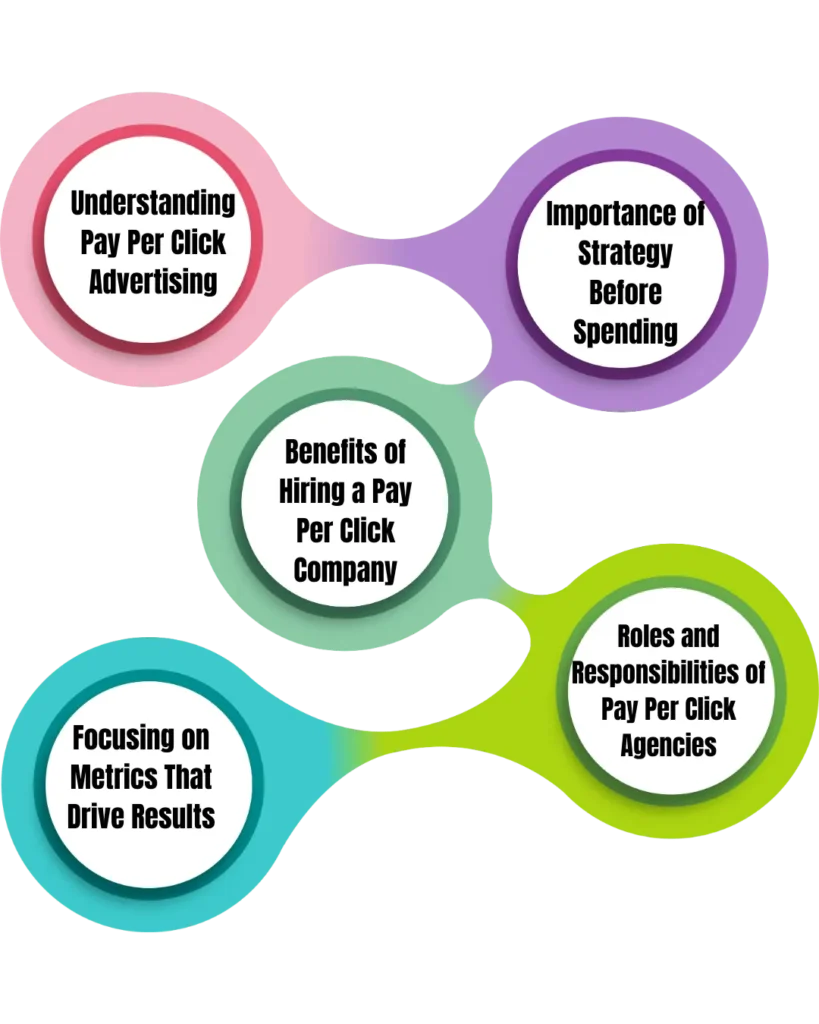
Measuring What Actually Matters
Clicks alone mean nothing. Any pay per click company worth hiring focuses on metrics that impact revenue, such as:
- Cost per acquisition (CPA)
- Conversion rate
- Return on ad spend (ROAS)
- Lead quality and funnel progression
Good agencies set up proper tracking and attribution so decisions are driven by data, not assumptions.
When Hiring a Pay Per Click Company Makes Sense
Hiring pay per click agencies is a smart move when:
- You need immediate, controlled traffic
- Organic channels take too long to scale
- Your cost per lead is rising
- Campaigns need consistent optimization
- Internal teams lack PPC expertise
However, PPC isn’t a replacement for weak positioning or unclear messaging. Ads amplify clarity; they don’t create it.
The Risk of Treating PPC as a Shortcut
PPC fails most often when businesses treat it as a hack rather than a discipline. Without aligned landing pages, clear value propositions, and realistic expectations, even well-run campaigns underperform.
Strong pay per click agencies will challenge assumptions, cut underperforming keywords, and prioritize profitability over vanity metrics.
Final Thoughts
Pay Per Click advertising is powerful—but only when managed strategically. Pay per click agencies bring structure, discipline, and optimization to a channel that punishes improvisation. Choosing the right pay per click company isn’t about finding the cheapest option; it’s about finding a partner who understands performance, intent, and long-term efficiency.
When done right, PPC becomes a scalable growth lever—not a recurring expense.
If your paid ads feel expensive, inconsistent, or directionless, the problem isn’t PPC—it’s how it’s being managed.
Explore how a performance-driven pay per click strategy can improve efficiency and results.
Visit www.digiactus.com to understand how data-led PPC management can support sustainable growth.