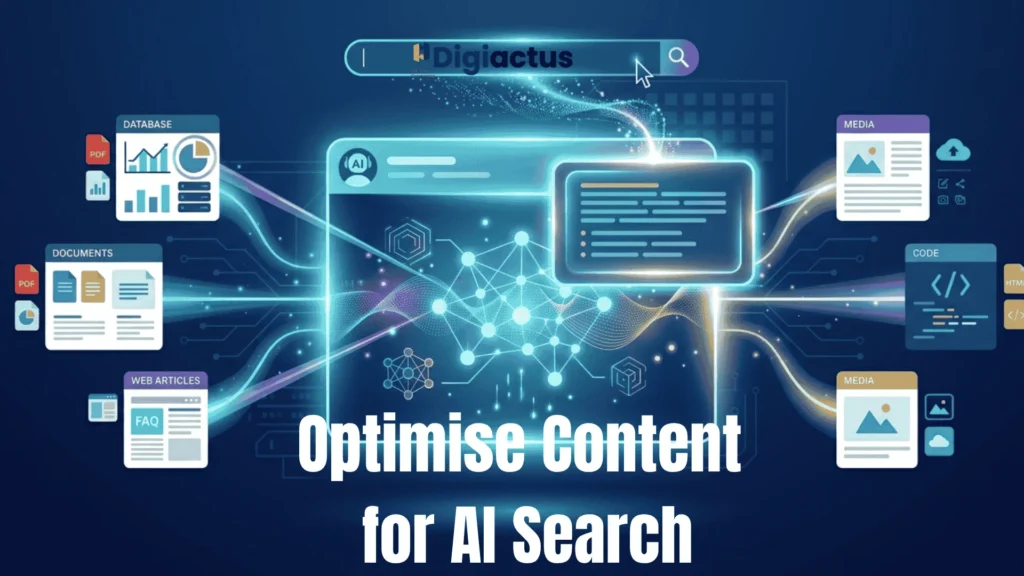
To optimise for AI search, structure your content with clear answers, entity-rich context, conversational language, and verifiable sources. AI engines prioritise content that directly answers questions, demonstrates authority, and is easy to extract into summaries.
Why “Optimise for AI Search” Matters Now
Search is no longer just about ranking on Google. Today, platforms like ChatGPT, Gemini, and Perplexity generate answers instead of listing links.
That shift changes everything.
Instead of asking “How do I rank?”, brands must now ask:
“How do I become the answer?”
According to insights from the UK SEO 2025 Annual Industry Report by Digiactus, over 68% of marketers observed declining CTRs from traditional search results due to AI-generated summaries, while AI-assisted discovery increased by 3X year-over-year.
So, if your content isn’t optimized for AI answer engines, it’s likely being ignored—even if it ranks.
What Is AI Optimization (GEO)?
AI Optimization (also called GEO – Generative Engine Optimization) is the process of structuring and enriching content so AI systems can understand, trust, and cite it in generated answers.
Unlike traditional SEO, AI optimization focuses on:
- Answerability (not just keywords)
- Context and entities
- Trust signals and citations
- Structured, extractable content
SEO vs AI Optimization (GEO): Key Differences
| Factor | Traditional SEO | AI Optimization (GEO) |
|---|---|---|
| Goal | Rank on SERPs | Get cited in AI answers |
| Content Style | Keyword-focused | Answer-focused |
| Structure | Blog/article | Modular, scannable answers |
| Success Metric | Traffic | Mentions, citations, visibility |
| Optimization | Backlinks, keywords | Entities, clarity, trust |
In short: SEO gets you seen. GEO gets you selected.
How AI Answer Engines Choose Content
AI engines choose content based on clarity, authority, structure, and relevance to user intent—not just keyword rankings.
Key Ranking Signals for AI:
- Direct Answer Coverage
Clear responses to specific questions - Topical Authority
Depth across a subject (not just one blog) - Entity Recognition
Mentions of brands, tools, concepts - Trust & Citations
Data-backed insights and credible references - Content Structure
Lists, tables, FAQs, and short paragraphs
Step-by-Step: How to Optimise Content for AI Search
Start With Questions, Not Keywords
AI-first content begins with user questions because AI engines are designed to answer queries, not just match keywords.
Instead of:
- “Good CRM tools”
Use:
- “What are the best CRM tools for startups?”
Use:
- Google “People Also Ask”
- Reddit threads
- AI chat prompts
Write Answer-First Content
Place the answer immediately after the heading to increase chances of being extracted by AI engines.
Example:
- H2: How to manage my customer database?
- First paragraph: Direct, concise answer (40–60 words)
Use Structured Formatting
AI prefers content it can scan and extract.
Best Formats:
- Bullet points
- Numbered steps
- Comparison tables
- FAQs
Add Entities and Context
Entities help AI understand who, what, and where your content relates to, improving visibility in AI-generated answers.
Examples of entities:
- Brands
- Tools
- Locations
- Concepts
Instead of:
- “Use tools”
Write:
- “Use CRM tools like Salesforce, Hubspot”
Build Topical Authority (Not Just One Blog)
The Digiactus report highlights:
Websites covering entire topic clusters were 2.7X more likely to be cited in AI answers
So instead of:
- 1 blog on CRM tools
Create:
- CRM tool guide
- Funnel checklist
- Customer Funnel Tracking guide
- Customer satisfaction case studies
Add Data, Statistics & References
AI engines prioritize content with verifiable data because it improves trust and reduces hallucination risk.
Example:
- “68% of marketers report declining CTR due to AI summaries (Digiactus UK SEO Report 2025)”
Optimize for Conversational Language
AI prefers natural language over robotic SEO writing.
Bad:
- “CRM tools for businesses implementation methodology”
Better:
- “How can you actually manage customer lead stage using CRM tools?”
Include FAQs (Critical for AI Extraction)
FAQs act as ready-made answer blocks for AI engines.
FAQs: Optimise for AI Search
What is AI search optimization?
AI search optimization is the process of structuring content so AI tools can understand, extract, and cite it in generated answers.
How is AI optimization different from SEO?
SEO focuses on rankings, while AI optimization focuses on being selected and cited in AI-generated responses.
Does keyword density matter in AI search?
No. Context, clarity, and relevance matter more than keyword frequency.
How do I know if my content is AI-friendly?
Check if:
- It answers questions clearly
- It includes structured sections
- It uses entities and data
Can small websites rank in AI answers?
Yes. AI engines prioritize quality and clarity over domain authority more than traditional search.
AI Optimization Checklist (Quick Reference)
| Task | Priority | Impact |
|---|---|---|
| Add direct answers under headings | High | High |
| Include FAQs | High | High |
| Use structured formatting | High | High |
| Add credible data | Medium | High |
| Build topic clusters | High | Very High |
| Use conversational tone | Medium | Medium |
Common Mistakes to Avoid
- Writing only for Google, not AI
- Overusing keywords unnaturally
- Ignoring structure and readability
- Not adding FAQs
- Publishing thin content
Final Thoughts: The Future Is Answer-Driven
AI search is not replacing SEO—it’s evolving it.
Brands that win will:
- Think like educators
- Write like humans
- Structure for machines
If your content is clear, credible, and contextual, AI will pick it.